How to Learn Reggaeton at Home (No Dance Experience Needed)
By Pao Ramirez | Zero to Dance Studio
You've heard the song a hundred times. It comes on at a party, at the beach bar, in the car with friends — and everyone around you seems to just know what to do. Their shoulders drop into the beat. Their hips find it without thinking. And you're standing there doing the polite bounce, hoping nobody's watching.
I want to tell you something that took me a long time to say out loud: those people are not doing anything you can't learn. Reggaeton looks effortless because it is simple — once someone actually shows you where the movement comes from. Nobody is born knowing it. They just grew up around it.
So here's how to learn reggaeton at home, from absolute zero, in your own living room, with nobody watching.
Start with the beat, not the steps
The single biggest mistake beginners make is trying to copy a video move-for-move before they can hear the rhythm underneath it. It's like trying to sing a song you've never heard.
Reggaeton runs on one repeating pattern — the dembow. Boom-ch-boom-chick. Boom-ch-boom-chick. Once you hear it, you cannot un-hear it, and it's in nearly every reggaeton song ever made.
Try this right now. Put on any reggaeton track you like. Don't move your feet. Just tap the pattern on your leg, or nod your head to it. Give it two or three full songs across a couple of days.
This sounds too simple to matter. It's the whole foundation. When your body already knows where the beat lives, the steps stop being choreography you have to memorize and start being something you land on.
It's also the one piece you can practise anywhere — on the bus, doing dishes, with nobody watching and no space at all. If you want the background on where that rhythm came from, we wrote a separate piece on what reggaeton dance actually is.
Practice short, practice often — and use a mirror
Ten minutes a day beats ninety minutes on Sunday. Every time.
Your body learns movement through repetition spread over time, not through one heroic session. Beginners who practice six or seven minutes most days progress dramatically faster than the ones who binge a whole course in one afternoon and then don't come back for two weeks. This is exactly why we built our courses as six lessons of four to seven minutes each — short enough that you'll actually press play tomorrow.
And use a mirror, or your phone propped up. Not to judge yourself — please, not that. To correct yourself. Almost everything that feels wrong when you're learning reggaeton is one small fixable thing: knees too straight, shoulders too high, moving on the wrong half of the beat. You'll spot it in five seconds on video and spend five weeks fighting it blindly without.
Record yourself early on. Save it. When you rewatch it later, you'll understand exactly why I'm telling you this.
Why free videos usually don't get you there
I'm not going to pretend there's nothing good on YouTube — there is. But I hear the same story constantly from people who arrive at Zero to Dance: "I tried learning from free videos and it never stuck."
It's worth understanding exactly why, because the reasons are fixable.
There's no order. Free videos are made to be watched, not to be learned from. Video one assumes you know nothing. Video two assumes you've danced for a year. Nothing builds on anything, so you never accumulate — you just keep starting.
They're filmed for people who already move well. Most tutorials demonstrate at full speed, beautifully, once. Nobody explains why a movement works or what it should feel like in your body, so when it doesn't look right you have no idea which part to change.
You spend your energy choosing instead of dancing. Ten minutes of searching, comparing thumbnails, and second-guessing is ten minutes you had for practice. A sequence removes that decision entirely — you press play on the next one.
Watching feels like progress. This is the sneakiest one. Your brain registers "I studied reggaeton today" after twenty minutes of watching, when your body did nothing. Stand up before you press play. Always.
What actually works for a total beginner is a short, ordered path where each lesson stands on the one before it, taught slowly, broken down, in a language you understand.
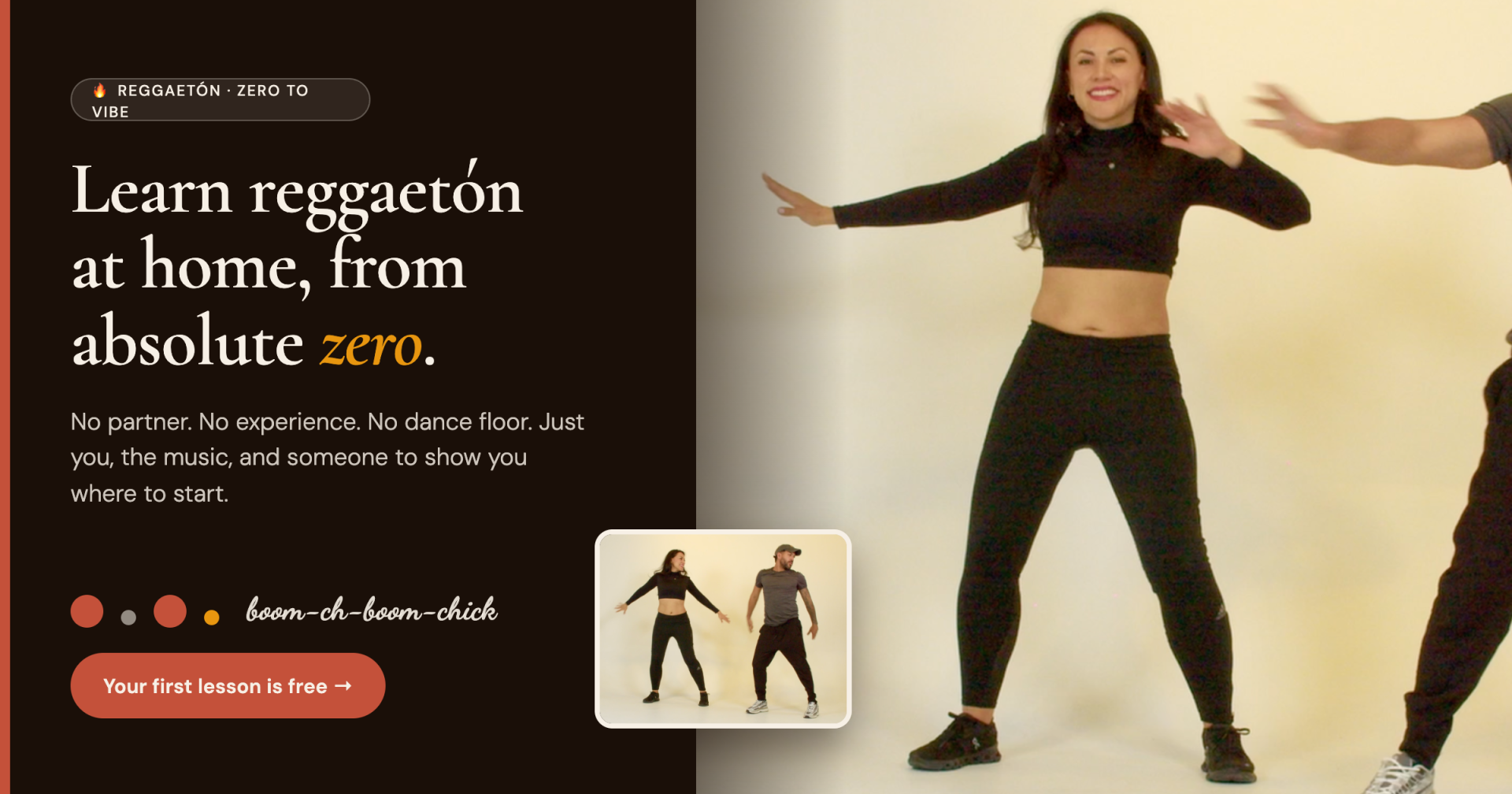
That's the whole reason Reggaeton: Zero to Vibe exists. Mau teaches the grooves, the attitude, and the body isolations from genuine zero — and I'm in every lesson as your dance buddy, asking the questions you'd ask and explaining everything in English as we go. You are not left alone with a professional dancer moving too fast. You've got someone learning right beside you.
Six lessons. Four to seven minutes each. No partner, no experience, no dance floor required. $24.90 once, yours for two years, with a 30-day money-back guarantee — and the first class is free, so you can feel it before you decide anything.
What you actually need to start (almost nothing)
People delay starting because they think there's a setup involved. There isn't. Here's the honest list.
Space. Roughly the size of a bath towel. Reggaeton doesn't travel — you stay more or less in one spot. If you can stand with your arms slightly out and not hit anything, you have enough room.
Shoes. None. Barefoot or socks-on-carpet is fine. If you're on a slippery floor, socks will actually help your knees stay soft instead of gripping.
A phone or laptop. Propped where you can see it. That's your whole studio.
Music you actually like. Not the "correct" learning playlist — the songs that already make you want to move. Motivation is a real part of technique.
Privacy, if you want it. Close the door. Genuinely. Feeling unobserved is what lets you stop being careful, and being careful is what makes people look stiff.
That's it. No mirror wall, no partner, no special clothes, no floor. The barrier was never the equipment.
And the moves themselves?
Everything above is the scaffolding — the part that decides whether you're still dancing in three weeks. The actual movements are simpler than you'd think, and we've broken all six of them down step by step, with a free video, in How to Dance Reggaeton: A Beginner's Guide. Start there once your setup is sorted.
The real reason to start
This was never about the steps.
It's about the next time a reggaeton song comes on and you don't have to decide whether to hide. It's about being the person who says yes when someone waves you over. It's about the specific, ridiculous joy of moving your body to music you love, in a way that feels like you.
You don't need talent. You don't need rhythm you were "born with." You don't need a partner, a studio, or anybody's permission. You need ten minutes, a song, and someone to show you where to start.
Start with the free first lesson of Reggaeton: Zero to Vibe — or browse all four beginner courses here.
Press play. I'll see you in there.
— Pao